
Company Agreements Across Arunachal Pradesh
Get Free Instant Quote
Document verification & doorstep courier across India.
What is Company Agreements Across Arunachal Pradesh in Arunachal Pradesh?
Company Agreements attestation in Arunachal Pradesh is the official government validation confirming the authenticity of your document for foreign visa and immigration use. The workflow involves sequential verification by Concerned State Home Department / Regional Authentication Centre, Arunachal Pradesh, the Ministry of External Affairs (MEA), and the destination country's embassy.
Corporate Legalization & Authentication for Company Agreements
International corporate registries and overseas banks (such as in Dubai, Singapore, London, and New York) mandate certified proof that company documents are legally executed under the Companies Act and certified by recognized commercial chambers.
ProAttestation delivers expedited commercial legalization for enterprises in Arunachal Pradesh, managing complete notarization, Chamber of Commerce endorsement, MEA stamping, and diplomatic embassy legalization.
Company agreements signed in India – MOUs, joint venture, partnership, distribution and service contracts – must be legalised before a foreign authority, bank or court will rely on them. Company agreement attestation is the route for non-Hague countries such as the UAE, Qatar and Kuwait, where the embassy and the foreign ministry must also stamp the document. For Hague Convention countries, such as the USA, the UK, Canada and Saudi Arabia, the same agreement needs the MEA apostille instead.
Comprehensive Guide to Company Agreements Across Arunachal Pradesh
Local Legalization Guidelines for Arunachal Pradesh
Important Guidelines for Company Agreements in Arunachal Pradesh: Before submitting your original documents for authentication, ensure that all certificates are in sound physical condition without heavy plastic lamination covering the reverse side. The Ministry of External Affairs (MEA) and foreign embassies affix official stamps and secure stickers directly to the paper; laminated documents must be carefully de-laminated by specialists before submission. Additionally, verify that the spelling of your name, date of birth, and parentage details match across your passport and original certificates. For destination countries adhering to the Hague Apostille Convention, a single MEA Apostille sticker is legally sufficient. For non-signatory nations—most prominently the UAE, Saudi Arabia, Qatar, Kuwait, and Oman—documents must complete the full bilateral sequence terminating with destination Embassy attestation and final in-country MOFA validation.
Tagline: Your contract, made valid abroad. We legalise MOUs, joint venture, partnership, distribution and other business agreements signed in India, choosing attestation or apostille according to the country where the agreement will be used.
Company agreements signed in India – MOUs, joint venture, partnership, distribution and service contracts – must be legalised before a foreign authority, bank or court will rely on them. Company agreement attestation is the route for non-Hague countries such as the UAE, Qatar and Kuwait, where the embassy and the foreign ministry must also stamp the document. For Hague Convention countries, such as the USA, the UK, Canada and Saudi Arabia, the same agreement needs the MEA apostille instead.
An agreement between two companies is a private document, so it cannot be legalised in the same way as a degree or a birth certificate. The signatures are first attested by a notary, the document is then verified by a Chamber of Commerce, and only then does the Ministry of External Affairs (MEA) add its attestation or apostille. This page explains both routes, covers MOU attestation, partnership agreement attestation, joint venture agreement apostille and commercial contract apostille, and lists which countries need which.
- MOUs, joint venture, partnership, shareholders', distribution, agency, licensing and service agreements
- Company agreement attestation for the UAE, Qatar, Kuwait and other non-Hague countries
- Apostille for agreements used in Hague countries
- Supporting documents – incorporation certificate, board resolution and power of attorney – under one order
- Doorstep pickup in Delhi NCR and tracked courier pickup from offices across India
Key Facts About Legalising Company Agreements
| Fact | Detail |
|---|---|
| Document type | A private document between the parties; it becomes legalisable through the notary's and the chamber's certification |
| Before legalisation | Properly stamped under the stamp law of the state where it is signed, and signed by authorised signatories |
| Usual verification in India | Notary, then Chamber of Commerce, then MEA |
| What the apostille or attestation proves | The signatures, seals and capacity of the officials who certified the document – not that the contract is valid or enforceable |
| Apostille countries | Hague members where the Convention applies with India – for example the USA, the UK, Canada, Australia, Saudi Arabia, Oman, Bahrain, Singapore and Vietnam |
| Attestation countries | UAE, Qatar, Kuwait, Malaysia, Egypt and other non-Hague countries; China because of India's objection |
| Germany | Indian apostilles have no legal effect; German authorities use their own verification |
| Fees | Depend on the agreement, the number of documents and the destination; shared after we review your documents |
What Counts as a Company Agreement?
A company agreement is any written contract that a company signs with another party. Foreign authorities, banks, partners and courts ask for legalised copies when the agreement will be relied on outside India. The most common ones are:
- Memorandum of understanding (MOU): records the intention of two or more parties to work together, often before a formal contract
- Joint venture agreement: sets out how two companies will run a shared business or project
- Partnership agreement or partnership deed: sets out the terms between partners in a firm
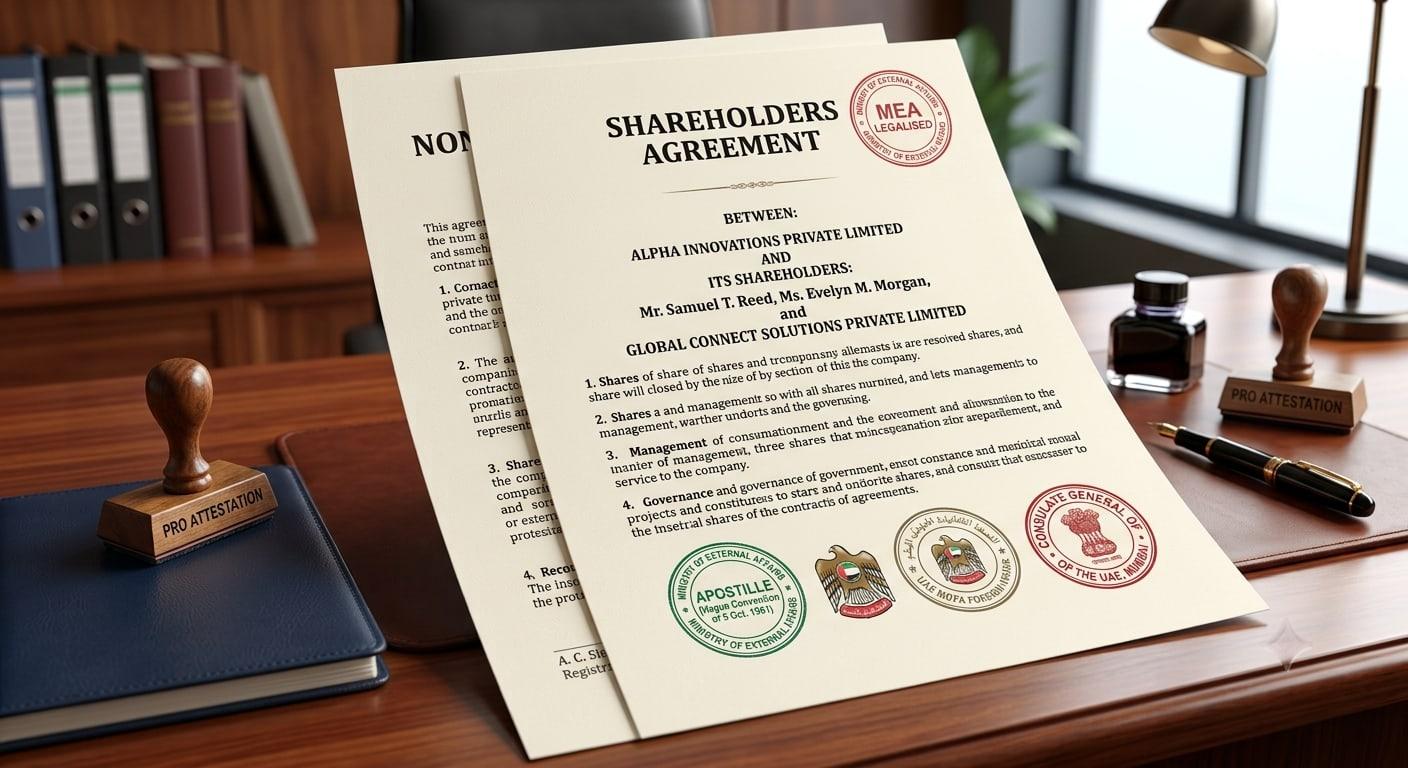
- Shareholders' agreement: governs the rights of shareholders in a company
- Distribution, dealership and agency agreements: appoint a party to sell or represent products in a territory
- Licensing and franchise agreements: allow a party to use a brand, technology or know-how
- Supply, service and consultancy contracts: cover the sale of goods and services
- Non-disclosure agreements (NDAs): protect confidential information shared between parties
The type of agreement does not change the legalisation route, but it often decides which supporting documents the foreign party will also want.
Private Documents: Why the Route Is Different
The Hague Apostille Convention applies to public documents. It treats notarial acts and official certificates placed on documents signed by private persons – such as a notary's certificate of signature – as public documents. That is why an agreement is first taken to a notary: the notary's certificate is the part that the chamber, MEA and the embassy can verify. The apostille or attestation confirms that certificate, not the commercial terms of the contract.
Stamp Duty Comes First
In India, an agreement must be stamped under the Indian Stamp Act, 1899 or the stamp law of the state where it is signed, usually on stamp paper or through e-stamping. An instrument that is not duly stamped can be refused as evidence. Notaries, chambers and foreign lawyers often check the stamping, so we make sure the agreement is stamped correctly before it moves forward. The amount depends on the state and the type of agreement, and we do not quote it here.
Who Signs, and With What Authority
Each company signs through an authorised person, usually a director or a person named in a board resolution or a power of attorney. Foreign parties often ask to see that authority. If the signatory's authority is not clear, the agreement can be questioned abroad even when every stamp is in place.
Company Agreement Attestation
Company agreement attestation is the chain of verifications that makes an agreement signed in India valid in a country that is not a member of the Hague Apostille Convention. It is needed for the UAE, Qatar, Kuwait, Malaysia, Egypt, Jordan, Iraq, Lebanon, Sri Lanka, Nepal and many African and Asian countries.
In attestation, each authority confirms the signature or stamp of the one before it. Only after the last stage – the embassy in India and, in the Gulf, the Ministry of Foreign Affairs (MOFA) – will the foreign authority, bank or free zone accept the agreement.
Company Agreement Attestation Process
Stage 1: Execution and Stamping
The agreement is printed, stamped under the applicable stamp law and signed by the authorised signatories. Every page is usually initialled, and the final page shows the names and designations of the signatories.
Stage 2: Notary Attestation
A notary appointed under the Notaries Act, 1952 attests the signatures. The notary checks the identity of the signatories, who usually sign in the notary's presence or confirm their signatures before the notary.
Stage 3: Chamber of Commerce Attestation
Commercial documents are verified by a recognised Chamber of Commerce before MEA. The chamber confirms the company and the notarised document and adds its stamp.
Stage 4: MEA Attestation
MEA attests the agreement after the chamber's verification. The MEA stamp is what the embassy checks next.
Stage 5: Embassy Attestation
The embassy of the destination country in New Delhi attests the agreement. Some embassies ask for a covering letter on company letterhead, copies of the signatories' passports or the company's incorporation certificate.
Stage 6: MOFA Attestation (Gulf Countries)
In the UAE, Qatar and Kuwait, the Ministry of Foreign Affairs completes the chain. For the UAE, one online application after MEA attestation covers both the UAE Embassy in New Delhi and the UAE MOFA.
MOU Attestation
MOU attestation follows the same route as any other agreement. Many companies assume that an MOU is too informal to need legalisation, but foreign free zones, ministries and banks often ask for an attested MOU before they register a project, allot land or open an account. Because an MOU is often signed quickly, check that it names the parties exactly as in their registration documents and that it is properly stamped before it goes to the notary.
Partnership Agreement Attestation
Partnership agreement attestation is common when an Indian firm or LLP sets up business abroad or appoints partners outside India. A partnership deed may be registered with the Registrar of Firms, and an LLP agreement is filed with the Ministry of Corporate Affairs. Either way, the signed deed or agreement is notarised, verified by the chamber and attested by MEA and the embassy. If the foreign authority also wants the firm's registration certificate, we plan both together.
Agreements for the UAE and the Gulf
UAE: distribution agreements, joint venture agreements, MOUs and service contracts are often needed for trade licences, free zone registration, bank accounts and tenders. After the notary, chamber and MEA stages, the UAE route is digital: one online application covers the UAE Embassy and the UAE MOFA, a MOFA-approved provider collects the original, and the digitally attested document is emailed. A power of attorney with commercial content is treated as a commercial document by the UAE Embassy, and commercial invoices and certificates of origin follow the separate eDAS route.
Qatar and Kuwait: both need embassy attestation in New Delhi after MEA, followed by their own Ministry of Foreign Affairs. Their requirements for commercial documents change from time to time, so we confirm the current list before pickup.
Saudi Arabia, Oman and Bahrain: these three are Hague members, so agreements for them need the apostille, not embassy attestation.
Other Non-Hague Countries
For Malaysia, Egypt, Jordan, Iraq, Lebanon, Sri Lanka, Nepal, Ethiopia, Nigeria, Kenya and similar countries, company agreement attestation follows the same route up to MEA, and then the embassy or high commission of that country in India attests it. Many of these missions also ask for a translation into their own language.
Company Agreement Apostille
A company agreement apostille is a single certificate from MEA that makes a notarised and chamber-verified agreement valid in every country where the Hague Apostille Convention applies with India. No embassy and no foreign ministry is needed after it.
The apostille confirms the authenticity of the signature, the capacity of the person who signed and the seal on the certificate it is attached to. It does not confirm the terms of the contract, and it does not make the contract enforceable in another country – that depends on the contract itself and the law that governs it. India joined the Convention with effect from 14 July 2005, and MEA is the only authority in India that issues apostilles.
Company Agreement Apostille Process
- Document check: we check the agreement, its stamping, the signatories and the destination country.
- Notary: the signatures are attested by a notary.
- Chamber of Commerce: the chamber verifies the notarised agreement.
- MEA apostille: MEA fixes its apostille sticker with a unique number to the document.
- Quality check and return: we photograph every stamp and return the agreement by tracked courier.
Joint Venture Agreement Apostille
A joint venture agreement apostille is needed when an Indian company forms a joint venture company or a contractual joint venture in a Hague country. Registries, banks and lawyers in the USA, the UK, Canada, Europe, Singapore, Australia and Saudi Arabia commonly ask for the apostilled agreement, together with the Indian partner's incorporation certificate and a board resolution approving the venture. Because joint venture agreements are often long, we check that every page is initialled and that any annexures are attached before the notary stage, so the apostille covers the complete document.
Commercial Contract Apostille
A commercial contract apostille covers supply, service, distribution, licensing and consultancy contracts used in Hague countries. Foreign courts, arbitration bodies, registries and banks ask for it when the contract is relied on as evidence or registered locally.
One point is specific to business papers. The Convention does not cover "administrative documents dealing directly with commercial or customs operations". A contract between companies is legalised through the notary's certificate, which is a public notarial act within the Convention. Invoices, certificates of origin and some customs papers can fall outside it, so a few countries still ask for those to be legalised at their embassy even when they accept apostilles for other documents. Our commercial document apostille service covers agreements together with the other business papers a company needs.
What an Apostilled or Attested Agreement Is Used For
- Registering a joint venture, subsidiary or branch abroad
- Opening corporate bank accounts and payment accounts abroad
- Appointing distributors, agents and franchisees
- Bidding for tenders and registering with foreign buyers
- Filing contracts with foreign courts, arbitration bodies or registries
- Investor, business and work visas where the agreement proves the business purpose
Hague and Non-Hague Countries: Apostille or Attestation?
The destination country decides the route. If the Hague Apostille Convention applies between India and that country, your agreement needs the apostille. If it does not, your agreement needs company agreement attestation. The tables below were checked against the Hague Conference status table in November 2026.
Hague Countries: Company Agreement Apostille
| Region | Countries where the MEA apostille is used |
|---|---|
| North America | USA, Canada (since 11 January 2024), Mexico |
| Europe | United Kingdom, Ireland, France, Italy, Spain, Portugal, Netherlands, Belgium, Switzerland, Austria, Poland, Sweden, Norway, Denmark, Finland, Greece and most other European countries (not Germany) |
| Middle East | Saudi Arabia (since 7 December 2022), Oman, Bahrain, Israel, Turkey |
| Asia-Pacific | Japan, South Korea, Singapore, Philippines, Indonesia, Bangladesh (since 30 March 2025), Vietnam (since 11 September 2026), Australia, New Zealand |
| Africa | South Africa, Mauritius, Morocco, Tunisia, Algeria (since 9 July 2026), Rwanda, Senegal |
| Latin America | Brazil, Argentina, Chile, Colombia, Peru and others |
Non-Hague Countries: Company Agreement Attestation
| Region | Countries where attestation (MEA + embassy) is needed |
|---|---|
| Gulf | UAE, Qatar, Kuwait (each followed by its own Ministry of Foreign Affairs) |
| Rest of the Middle East | Egypt, Jordan, Iraq, Lebanon, Iran |
| Asia | Malaysia, Sri Lanka, Nepal, Myanmar, Cambodia, Laos, Afghanistan; Thailand until its accession takes effect on 28 February 2027 |
| Africa | Ethiopia, Nigeria, Kenya, Tanzania, Uganda and other non-member countries |
| Special case | China – it joined the Convention in 2023, but India objected, so the Convention does not apply between India and China |
Special Cases You Should Know
- Germany: Germany objected to India's accession in 2005, and the objection still stands, so an Indian apostille has no legal effect for German authorities. German missions in India stopped legalising Indian documents in 2000 and use document verification instead, which only a German authority can request.
- China: agreements for China need MEA attestation followed by legalisation at the Chinese Embassy or a Chinese Consulate in India.
- Vietnam: from 11 September 2026, the Vietnamese Embassy in New Delhi stopped consular legalisation of Indian public documents covered by the Convention. Documents outside the Convention, such as certain administrative documents tied to commercial or customs activity, can still be legalised at the embassy.
- Thailand: Thailand has joined, but the Convention takes effect only on 28 February 2027. Until then, Thailand still needs attestation.
- Canada and Saudi Arabia: both moved from embassy legalisation to the apostille (Canada in January 2024, Saudi Arabia in December 2022), so older advice that asks for embassy attestation is out of date.
Apostille or Attestation: Quick Comparison
| Point | Company agreement apostille | Company agreement attestation |
|---|---|---|
| Countries | Hague members where the Convention applies with India | Non-Hague countries, China and countries not yet in force |
| Stages in India | Notary, Chamber of Commerce, MEA apostille | Notary, Chamber of Commerce, MEA attestation, embassy |
| After India | Nothing (translation if asked) | Ministry of Foreign Affairs in Gulf countries |
| Proof | Apostille sticker with a unique number | Stamps of each authority |
| Usual time | Shorter | Longer, because of the embassy and MOFA |
When Legalisation Is Not Needed
Not every contract needs an apostille or attestation. Many foreign companies sign contracts with Indian partners and rely on scanned copies, e-signatures or their own checks, without asking for any legalisation. Company agreement attestation or an apostille is usually needed only when the agreement goes to a government body, a registry, a bank, a court or an arbitration body abroad, or when the foreign party's lawyer insists on it. Ask the foreign party in writing before you start, because legalising a contract that nobody will ask for wastes time.
Electronically Signed Agreements
Indian law recognises electronic signatures under the Information Technology Act, 2000, and many contracts are now signed online. Legalisation, however, still runs on paper: the notary, the chamber, MEA and the embassy stamp a physical document. If your agreement was signed electronically and the foreign party needs it legalised, the usual solution is for the signatories to sign a printed original in wet ink, or to sign a printed confirmation before the notary. We check what the foreign party will accept before anything is re-signed.
Agreements for Tenders and Government Bodies Abroad
Foreign ministries, state companies and municipal bodies often ask bidders to submit legalised copies of their joint venture or consortium agreements, along with the incorporation certificate, a board resolution and a power of attorney for the person who will sign the bid. Tender deadlines are fixed, so start the legalisation as soon as the agreement is signed. For non-Hague countries, the embassy stage usually takes the longest, so company agreement attestation for tenders should be planned around it.
Notarised Copy, Certified Copy or Legalised Agreement?
Foreign parties use these words loosely, and the difference decides how much work is needed.
| What they ask for | What it means | Is it enough on its own? |
|---|---|---|
| Certified copy | A copy certified as true by a director, company secretary, lawyer or notary | Only if the foreign party says so |
| Notarised agreement | The agreement with a notary's certificate on the signatures | Rarely enough abroad; it is the first step of legalisation |
| Apostilled agreement | The notarised and chamber-verified agreement with the MEA apostille | Yes, in Hague countries |
| Attested or legalised agreement | The agreement with MEA and embassy stamps (and MOFA in the Gulf) | Yes, in non-Hague countries |
When a Gulf authority writes "attested", it means full company agreement attestation through MEA and the embassy, not a notary stamp alone. Getting this one word right saves a full round of work.
Amendments, Addenda and Renewals
If an agreement is amended, extended or renewed after it was legalised, the amendment is a new document and needs its own legalisation. The original legalised agreement stays valid as it was. Keep the amendment's wording consistent with the original – same party names, same dates and same references – so that the foreign authority can read the two together without questions.
Agreements Signed in Two Countries
Many contracts are signed by an Indian company in India and by a foreign company abroad. Legalisation follows the place where each signature was made:
- Signed in India: the Indian signature is notarised in India and goes through the chamber and MEA.
- Signed abroad: the foreign signature is legalised in that country, under its own rules, and usually cannot be handled by MEA.
- Signed in counterparts: each party signs a separate original; each original is legalised where it was signed.
If you want one fully legalised document, the simplest way is to have all Indian signatories sign together in India before the notary, and to ask the foreign party to legalise their own counterpart in their country. We help you plan this before signing, which avoids having to re-sign later.
Multiple Originals and Copies
Joint ventures and distribution deals often have two or more originals – one for each party, and sometimes one for a registry. Each original that will be used abroad needs its own legalisation. If the foreign authority accepts a certified copy instead, a notarised copy can sometimes be legalised in place of a second original. Ask which they accept before signing extra originals.
Bilingual and Foreign-Language Agreements
Agreements for the Gulf, Latin America and parts of Europe are often drafted in two languages, side by side. A bilingual agreement can be legalised as one document. If the agreement is entirely in a foreign language, the notary and the chamber must still be able to understand what they are certifying, so an English version or translation may be needed in India. We check this before the notary stage.
Documents Usually Legalised With an Agreement
Foreign parties rarely ask for the agreement alone. They usually want proof that the Indian company exists and that the signatory was authorised:
| Document | Why it is asked for |
|---|---|
| Certificate of incorporation | Proves that the Indian company exists |
| Board resolution | Approves the agreement and authorises the signatory |
| Power of attorney | Authorises a person to sign or act for the company abroad |
| MOA and AOA | Show the company's objects and rules |
| Partnership deed or LLP agreement | For firms and LLPs instead of incorporation documents |
Each document is legalised separately, with its own stamps. We plan the full set together so that every document reaches the embassy in the same batch.
Supporting Documents by Agreement Type
| Agreement | Supporting documents foreign parties often ask for |
|---|---|
| MOU | Incorporation certificate; board resolution or letter authorising the signatory |
| Joint venture agreement | Incorporation certificate, board resolution approving the venture, MOA and AOA, power of attorney |
| Partnership agreement or deed | Firm's registration certificate or LLP incorporation certificate; ID of partners |
| Distribution or agency agreement | Incorporation certificate, IEC for exporters, board resolution |
| Licensing or franchise agreement | Incorporation certificate; trademark or patent registration, where relevant |
These lists are typical, not fixed. The foreign party decides, so we always work from their written request.
Questions to Ask the Foreign Party Before You Start
- Do you need an apostille, embassy attestation or only a notarised copy?
- Which supporting documents do you need with the agreement?
- Must every signatory sign before a notary, or only the Indian company?
- How many legalised originals do you need?
- Do you need a translation, and must the translator be sworn in your country?
- Must the agreement be registered or stamped again your country after it arrives?
Share their reply with us. We match the route and the document list to it, so the agreement is accepted the first time.
Documents Required
| Document | Why it is needed |
|---|---|
| Signed and stamped agreement (original) | The document to be legalised |
| Board resolution or authority of the signatory | Confirms the signatory could sign for the company |
| ID copies of the signatories | Needed by the notary and some chambers and embassies |
| Covering letter on company letterhead | Some embassies ask for the purpose and destination |
| Supporting company documents | Only if they are also to be legalised |
| Destination country and purpose | Decides apostille or attestation |
We tell you the exact list for your country before pickup, because embassies change their requirements for commercial documents more often than for personal documents.
How Long Does It Take?
| Route | Indicative time in India |
|---|---|
| Company agreement apostille | About 4–8 working days after the agreement is signed and stamped |
| Company agreement attestation (UAE) | About 7–12 working days, plus the online UAE stage |
| Company agreement attestation (Qatar, Kuwait, others) | About 10–20 working days, depending on the embassy |
| Agreement with supporting documents | Planned together; usually the same as the slowest document |
These timelines are indicative only. Embassy holidays, public holidays and queries from any authority can change them. We confirm the timeline for your country before you send the documents.
Companies Outside Delhi
Agreements do not go through a state education or home department, so company agreement attestation follows the same route wherever your company is based, from Mumbai and Bengaluru to Ahmedabad, Hyderabad or Kolkata. What changes is only the pickup. We collect documents from offices in Delhi NCR at your doorstep and from other cities through a tracked courier, handle the notary, chamber, MEA and embassy stages, and send the legalised agreement back the same way. If your signatories are in different cities, we help you plan where and how they sign so the notary stage is not delayed.
Three Typical Situations
A Distribution Agreement for a Dubai Partner
A Gujarat chemicals exporter appointed a distributor in Dubai. The UAE partner needed the attested distribution agreement for its trade licence. The agreement was stamped, notarised and verified by the chamber, attested by MEA, and then one online application covered the UAE Embassy and the UAE MOFA.
A Joint Venture in Saudi Arabia
A Chennai engineering company signed a joint venture agreement with a Saudi partner. Its consultant had asked for Saudi Embassy attestation, which is no longer the route for documents covered by the Convention. Because Saudi Arabia has been a Hague member since 2022, the agreement, the incorporation certificate and the board resolution were apostilled instead.
A Partnership Agreement for Canada
A Delhi firm entered a partnership with a Canadian company. Since Canada joined the Convention in January 2024, the partnership agreement and the firm's registration documents went through the notary, the chamber and the MEA apostille, with no visit to the Canadian High Commission.
Common Mistakes With Company Agreements
- Unstamped or under-stamped agreements, which can be refused at the notary or abroad
- Signatory without clear authority, with no board resolution or power of attorney
- Missing pages or annexures, so the legalised document is incomplete
- Apostille for the UAE, Qatar or Kuwait, where attestation is needed
- Embassy attestation for Saudi Arabia, Oman or Bahrain, where the apostille is enough
- Apostille for China or Germany, where it has no effect
- Expecting MEA to legalise a signature made abroad
- Changing the agreement after legalisation, which means starting again
- Legalising an electronically signed printout without a wet-ink original or a notarised confirmation
- Legalising only one original when the foreign registry and the partner each need their own
- Starting late for tenders, when the embassy stage alone can take longer than the time left before the deadline
Translation After the Apostille or Attestation
Countries that do not use English often want a sworn or certified translation of the agreement. For apostille countries, the usual order is to finish the apostille and then translate the whole document, including the stamps. For attestation countries such as the UAE, an Arabic translation is often requested by the local authority after attestation. Some countries accept only their own sworn translators, so we check before arranging a translation in India.
How to Check an Apostille or Attestation
Every MEA apostille carries a unique number that can be checked on MEA's verification facility. Make sure the sticker is fixed to the right agreement and that the company names are correct. For attestation, check that every stage – notary, chamber, MEA, embassy and, in the Gulf, MOFA – appears in that order. For UAE digital attestation, keep the emailed document safe, because that is what UAE authorities verify.
Confidentiality and Safe Handling
Company agreements contain prices, terms and trade secrets, so we treat them as confidential. Only the people working on your order see them. Every document is logged with a written receipt at pickup, moved only through tracked couriers and stored securely between stages. We share photos of every stamp before dispatch and return documents only to the company or the person it authorises.
Why Choose Pro Attestation for Your Company Agreements?
- Right route first: apostille or attestation, checked for your destination country
- Stamping and authority checks before the notary stage
- Full company files planned together, so all documents reach the embassy at once
- Correct country lists, including recent changes such as Canada, Saudi Arabia, Bangladesh and Vietnam
- Confidential handling of commercial terms
- Clear fees discussed before any work begins
- Serving clients since 2015
Frequently Asked Questions About Company Agreements
1. What is company agreement attestation?
It is the legalisation of an agreement signed in India for a non-Hague country: notary, Chamber of Commerce, MEA attestation, the embassy and, in the Gulf, MOFA.
2. What is MOU attestation?
It is the attestation of a memorandum of understanding through the same route, so that a foreign authority, free zone or bank can rely on it.
3. What is a joint venture agreement apostille?
It is the MEA apostille on a notarised and chamber-verified joint venture agreement, accepted in Hague countries without an embassy stage.
4. What is partnership agreement attestation?
It is the legalisation of a partnership deed or LLP agreement for use abroad, through the notary, chamber, MEA and, for non-Hague countries, the embassy.
5. What is a commercial contract apostille?
It is the MEA apostille on a notarised commercial contract, such as a supply, service, licensing or distribution agreement, for use in Hague countries.
6. Does the agreement need to be on stamp paper?
It must be stamped under the stamp law of the state where it is signed. An unstamped agreement can be refused as evidence and by some authorities.
7. Why is a notary needed?
An agreement is a private document. The notary's certificate on the signatures is what the chamber, MEA and the embassy can verify.
8. Is Chamber of Commerce attestation needed?
Yes, commercial documents are usually verified by a Chamber of Commerce before MEA. We confirm the current route before starting.
9. Does the apostille make the contract enforceable abroad?
No. It proves the signatures and seals. Whether the contract is enforceable depends on its terms and the law that governs it.
10. Can an agreement signed abroad be legalised in India?
A signature made abroad is usually legalised in that country. MEA legalises documents signed or certified in India.
11. Can several agreements be legalised together?
Yes. Each one receives its own stamps, but we process them as one batch.
12. Is a board resolution needed?
Often yes. Foreign parties want proof that the signatory was authorised by the company.
13. Does Saudi Arabia need embassy attestation for agreements?
No. Saudi Arabia has been a Hague member since 7 December 2022, so the apostille is used.
14. Can NDAs be legalised?
Yes. An NDA follows the same route as any other agreement, if the foreign party needs it legalised.
15. How much does company agreement attestation cost?
It depends on the agreement, the number of documents and the destination. Our team shares the exact total after reviewing your documents.
16. Is my agreement kept confidential?
Yes. Only the people working on your order see it, and documents move only through tracked couriers.
Related Services
Commercial Document Apostille | Certificate of Incorporation | Board Resolution | Power of Attorney | MEA Apostille | Embassy Attestation
Start Legalising Your Company Agreements Today
Send a copy of your agreement, the list of other company documents and the destination country. We will confirm whether you need an apostille or attestation, check the stamping and the signatories, discuss the fees with you and arrange pickup.
Contact Details
Office Address
Pro Attestation Services, Office No. S204, 2nd Floor, Balaji Building, Property No. 40-A, Corner Market, Malviya Nagar, New Delhi 110017
Phone and WhatsApp
+91 8700770603 | +91 8595563930
Sources: HCCH Apostille Convention status table and text of the Convention (Article 1); Ministry of External Affairs – Attestation and Apostille; Indian Stamp Act, 1899; Notaries Act, 1952; UAE Embassy New Delhi – Attestation Information; Embassy of Vietnam in India – notice on the Apostille Convention (September 2026); German missions in India – verification of Indian documents.
Verification & Attestation Process for Arunachal Pradesh
Notary Public Attestation
Chamber of Commerce Legalization
Ministry of External Affairs (MEA) Apostille / Attestation
Embassy Legalization (Non-Hague)
MOFA Legalization (Overseas)
Documents Required for Company Agreements Across Arunachal Pradesh
Why Trust Pro Attestation in Arunachal Pradesh?
Complimentary doorstep pickup across Delhi NCR and tracked insured courier services across all Indian states.
Direct, verified authentication through authorized government ministries, chambers, and diplomatic missions.
Complete turnaround in 2 to 4 working days for urgent commercial and visa deadlines.
Clear fee structures with no hidden fees, transparent consular embassy receipts, and itemized billing.
Real-time updates via WhatsApp and phone with end-to-end document tracking.
Frequently Asked Questions
Company Agreements Attestation and Apostille Services
Get Free Document Quote
Get custom pricing & verified turnaround time instantly in Arunachal Pradesh
- Company Agreements Across Arunachal Pradesh in Itanagar
- Company Agreements Across Arunachal Pradesh in Naharlagun
- Company Agreements Across Arunachal Pradesh in Pasighat
- Company Agreements Across Arunachal Pradesh in Tawang
- Company Agreements Across Arunachal Pradesh in Ziro
- Company Agreements Across Arunachal Pradesh in Roing
- Company Agreements Across Arunachal Pradesh for Afghanistan
- Company Agreements Across Arunachal Pradesh for Albania
- Company Agreements Across Arunachal Pradesh for Andorra
- Company Agreements Across Arunachal Pradesh for Angola
- Company Agreements Across Arunachal Pradesh for Algeria
- Company Agreements Across Arunachal Pradesh for Argentina
Company Agreements Attestation and Apostille Services
Pro Attestation is a reliable name for Certificate Attestation in India, offering complete certificate attestation services for students, professionals, families and businesses. Every Indian document that is used abroad needs official verification, and attestation is the legal process that makes your certificate acceptable to foreign governments, employers and universities. We handle personal, educational and commercial documents through the genuine government chain, from notary and state departments to the Ministry of External Affairs, the embassy and the foreign ministry.
For documents going to the United Arab Emirates, we provide complete UAE embassy attestation for degree certificates, diplomas, marriage certificates, birth certificates, PCC and commercial documents. Because the UAE is not part of the Hague Convention, an apostille is not accepted there. After UAE embassy attestation, documents need MOFA attestation by the UAE Ministry of Foreign Affairs, which is the final step that makes them valid for employment visas, family visas, equivalency certificates and business licences. Pro Attestation manages both stages together, so you do not have to arrange MOFA attestation separately after reaching the UAE.
Educational certificates first need HRD attestation from the Human Resource Development Department of the state where they were issued. HRD attestation confirms that your degree, diploma or mark sheet is genuine and is mandatory before MEA attestation or apostille. We cover HRD attestation for every Indian state, including the extra Home Department and Norka Roots step for certificates issued in Kerala, and the Mantralaya process in Maharashtra.
For countries that are members of the Hague Convention, our apostille services offer a faster and simpler route. A single MEA apostille sticker makes your document valid in more than 120 countries, including the USA, UK, Canada, Germany, France, Italy, Australia, Japan and South Korea. Our apostille services cover educational certificate apostille, personal document apostille, PCC apostille and commercial document apostille for study, work, permanent residence and business.
Whether you need certificate attestation for a job in Dubai, apostille services for a master's degree in Germany, HRD attestation for your engineering degree, UAE embassy attestation for a marriage certificate, or MOFA attestation for a family visa, Pro Attestation handles the full process from start to finish. Our certificate attestation services include doorstep pickup and delivery across India, real-time WhatsApp updates, transparent pricing and expert guidance on the latest embassy rules. We serve clients in Delhi NCR, Mumbai, Bengaluru, Hyderabad, Chennai, Kolkata, Pune, Ahmedabad, Jaipur, Lucknow, Patna, Chandigarh, Kochi and every other city in India, as well as NRIs living abroad.
Our team also offers certified translation into Arabic and other languages, so your attested documents are ready for any authority abroad. Since 2015, thousands of clients have trusted Pro Attestation for fast, genuine and hassle-free certificate attestation. Call or WhatsApp +91 8700770603 today for a free consultation and get your documents attested the right way, the first time. Your documents, your timeline and your trust are always in safe hands with us.