
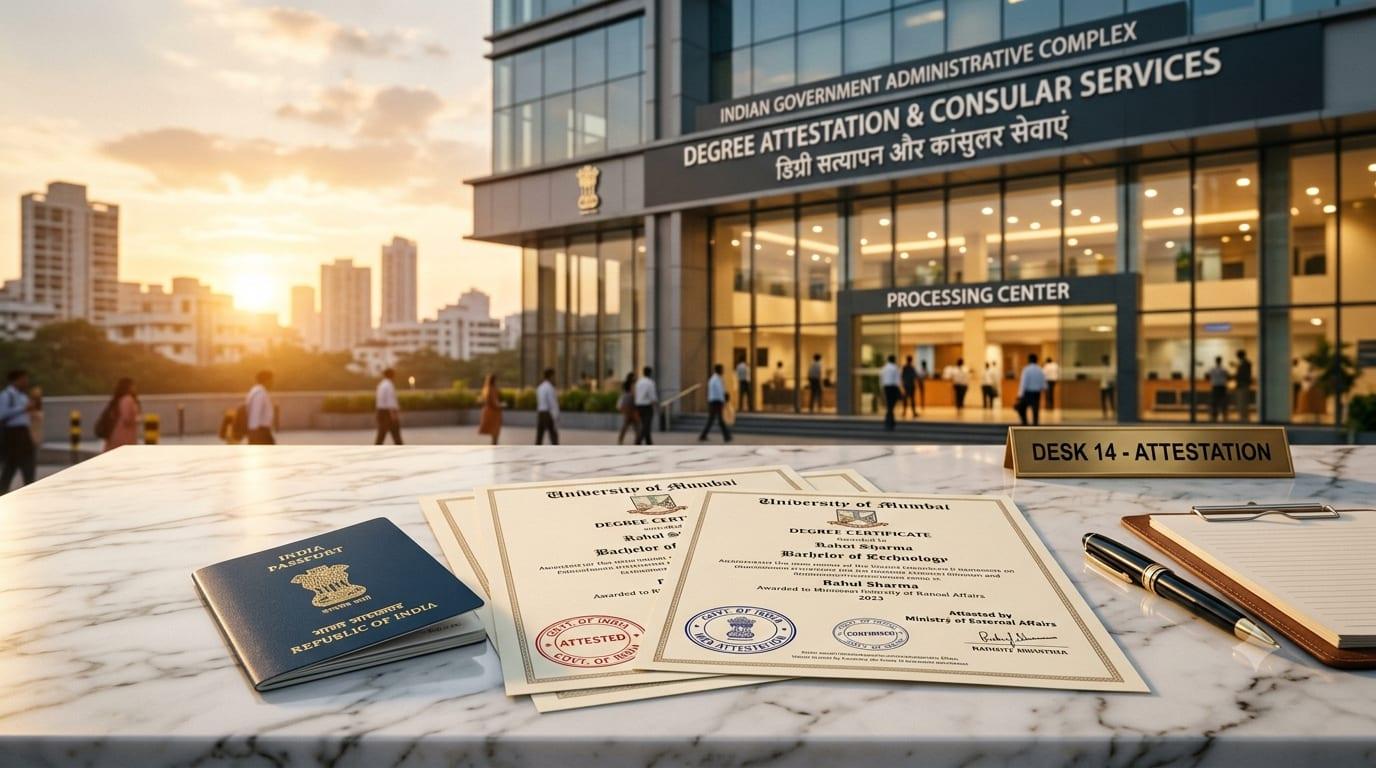
How to apostille a document in India comes down to three stages: get the document notarised if it is a private document, get it verified by the correct state authority or Chamber of Commerce, and then get the apostille sticker from the Ministry of External Affairs (MEA). The exact first step depends on whether your document is educational, personal or commercial.
That is the short version. The longer version is where people lose weeks. A degree from Pune does not start at the same desk as a birth certificate from Delhi. A Passport Office police certificate skips a stage that a district police certificate cannot skip. A company's incorporation certificate goes to a Chamber of Commerce, not to a Home Department.
This guide is a practical walkthrough of how to apostille a document in India. It does not spend long on theory. Instead, it takes each common document type and shows you, step by step, where it starts, where it goes next and what to keep ready. It also covers the offline route through agencies, realistic timelines, a preparation checklist and the mistakes we see most often in files that arrive at our Malviya Nagar office.
Key Facts About How to Apostille a Document in India
Keep these apostille India facts in front of you before you start. They decide your route.
| Point | Detail |
|---|---|
| Issuing authority | Ministry of External Affairs (MEA), Government of India - the only apostille authority in India |
| Legal basis | Hague Apostille Convention of 5 October 1961; in force for India since 14 July 2005 |
| Where it works | Hague member countries that accept Indian apostilles (130 contracting parties as of June 2026) |
| Where it does not work | Germany and China (objections), and non-members such as UAE, Qatar, Kuwait, Malaysia, Ethiopia |
| First step for degrees | University verification where required, then state HRD / Education Department |
| First step for personal documents | State Home Department, GAD or SDM (SDM in Delhi) |
| First step for company documents | Chamber of Commerce |
| Passport Office PCC | Goes directly to the MEA |
| Form of apostille | Square, computer-generated sticker on the back, with a unique number verifiable online on the MEA website |
Do You Need an Apostille or Attestation?
You need an apostille only if the country where you will use the document is a Hague Convention member that accepts Indian apostilles. If the country is not a member, or if an objection blocks the Convention between that country and India, you need attestation instead. Check this before anything else, because the two routes split after the MEA stage.
Here is a quick test:
- Going to the UK, USA, Canada, Australia, New Zealand, France, Italy, Spain, the Netherlands, Japan, South Korea or Poland? You need an apostille.
- Going to Saudi Arabia, Oman or Bahrain? These are Hague members, so you need the MEA apostille. Since November 2022, Indians generally do not need a PCC for Saudi visas.
- Going to the UAE, Qatar, Kuwait, Malaysia or Ethiopia? These are not Hague members. You need state verification, MEA attestation and embassy attestation, plus MOFA for the Gulf countries.
- Going to Germany? Germany objected to India's accession and has not withdrawn that objection, so an Indian apostille has no effect there. The German missions in India have their own document verification procedure.
- Going to China? China joined in 2023, but India objected to China's accession on 8 September 2023. Indian documents still need MEA attestation and then legalisation at the Chinese Embassy or a Chinese Consulate in India.
If you are unsure, ask the receiving university, employer or registry to name the exact certificate they want. Write their answer down. In our experience, a one-line email from the receiving side saves more time than any other single step.
How to Apostille a Document in India: The Three-Stage Route
Every apostille India application follows the same skeleton, whatever the document. Only the authority at stage two changes.
- Stage 1 - Notary (only if needed). Private documents, such as affidavits, declarations and powers of attorney, must be signed before a notary first. Public documents, such as a registrar's birth certificate or a university degree, usually skip this stage.
- Stage 2 - Prior verification. The authority that knows the document checks it. For education, that is the state HRD or Education Department, often after the university confirms the degree. For personal documents, it is the state Home Department, GAD or SDM. For commercial documents, it is a Chamber of Commerce.
- Stage 3 - MEA apostille. The MEA fixes the apostille sticker on the back of the original. The sticker carries a unique number that can be verified online.
The table below shows the same route in a form you can print and keep:
| Stage | Who acts | What they check | Who needs it |
|---|---|---|---|
| Notary | Notary public | Your identity and signature on a private document | Affidavits, declarations, powers of attorney, some copies |
| University verification | Your university | That the degree or marksheet was issued by it | Educational documents, where the state requires it |
| State verification | HRD / Education Dept, Home Dept, GAD or SDM | Signature and seal of the issuing office | Educational and personal documents, state police PCC |
| Chamber of Commerce | A recognised Chamber | Company or trade document | Commercial documents |
| MEA apostille | Ministry of External Affairs | Prior verification and document | Every document for a Hague country that accepts Indian apostilles |
Notice what is missing: an embassy. That is the whole point of the apostille. Once the MEA sticker is on, nothing more is needed from India for a Hague member country that accepts Indian documents.
Explore apostille India application →
Which Documents Can You Apostille, and Where Does Each One Start?
You can apostille most Indian public documents: educational certificates, civil registry certificates, court documents, notarised documents and commercial papers. What differs is the starting desk. The table below is the quickest way to find yours, and it is the first thing to check when working out how to apostille a document in India. If your document is not listed, it usually falls into one of these three families.
| Document | Family | Where it starts | Notary needed? |
|---|---|---|---|
| Degree, provisional degree, diploma | Educational | University (where required), then state HRD / Education Dept | No |
| Marksheets, transcripts | Educational | University or board, then state HRD / Education Dept | No |
| Class 10 / 12 certificates | Educational | Board, then state HRD / Education Dept | No |
| Transfer or leaving certificate | Educational | School, then state Education Dept | Depends on the state |
| Birth certificate | Personal | State Home Dept, GAD or SDM | No |
| Marriage certificate | Personal | State Home Dept, GAD or SDM | No |
| Death certificate | Personal | State Home Dept, GAD or SDM | No |
| Affidavit, single status declaration | Personal | Notary, then state Home Dept, GAD or SDM | Yes |
| Power of attorney | Personal | Notary, then state verification | Yes |
| PCC from Passport Seva / PSK | Personal | Directly to MEA | No |
| PCC from state or district police | Personal | State verification, then MEA | No |
| Certificate of incorporation, board resolution, invoice | Commercial | Chamber of Commerce | Sometimes |
In Maharashtra, educational documents go through the Mantralaya. In Kerala, educational certificates get HRD attestation through Norka Roots, which has centres in Thiruvananthapuram, Ernakulam and Kozhikode, and Kerala personal documents get Home Department attestation through Norka Roots as well. Educational certificates do not need Home Department attestation in any state.
How Do You Apostille Educational Documents?
To apostille an educational document, first get it verified by your university or board where the state requires it, then by the state HRD or Education Department of the state where it was issued, and finally submit it to the MEA for the apostille. Degrees, marksheets and diplomas all follow this route.
Step-by-Step for a Degree Certificate
- Collect the original degree and, if possible, the matching marksheets. Check that your name, father's name and course match on all of them.
- University verification. Many states want the university to confirm the degree before state verification. Your university may need a request letter, a copy of your ID and the original.
- State HRD or Education Department verification. The department of the state where the university sits verifies the signature and seal. A degree from a Pune university goes through the Maharashtra route (Mantralaya), not through Delhi, even if you now live in Delhi.
- MEA apostille. The verified degree goes to the MEA, which fixes the apostille sticker on the back.
- Check and verify. When the degree returns, check the sticker and verify the number online.
Marksheets, Transcripts and School Certificates
Marksheets follow the same route as degrees. Many universities abroad want every semester's marksheet, so ask the receiving university which ones they need before you send the full set. Apostilling marksheets you will not use only adds time.
Class 10 and Class 12 certificates go through the state's education department, based on the board that issued them. For a central board certificate, the verifying office can depend on the state where you studied, so we confirm the correct office before sending anything.
Example: A Graduate Going to France
Suppose you finished an engineering degree in Pune and have a master's offer in France. France is a Hague member and accepts Indian apostilles. Your route is university verification, then Maharashtra verification through the Mantralaya, then the MEA apostille. You will probably also need a French translation done in France or by a translator the university accepts. The apostille does not replace that translation.
Explore apostille an educational document →
How Do You Apostille Personal Documents?
To apostille a personal document such as a birth, marriage or death certificate, get the original verified by the Home Department, GAD or SDM of the state that issued it, then submit it to the MEA for the apostille. In Delhi, the SDM handles this verification. Affidavits need a notary first.
Birth Certificate
Use the birth certificate issued by the Registrar of Births and Deaths under the Registration of Births and Deaths Act, 1969. A hospital discharge slip or hospital birth record is not the official birth certificate and should not be sent for apostille. The 2023 amendment to the Act, in force from 1 October 2023, introduced digital birth certificates, so ask the receiving authority whether a digital certificate is acceptable to them or whether they want a printed one.
For visas, the child's name must appear on the certificate. Certificates issued without a name, which is common when parents register the birth before naming the child, should be updated through the registrar first.
Example: parents in Delhi applying for a Canadian dependent visa for their child would get the registrar's birth certificate, have it verified by the Delhi SDM, and then get the MEA apostille. Canada has been a Hague member since 11 January 2024.
Marriage Certificate
A marriage certificate issued by a registrar is the safest document to apostille. It may be issued under the Hindu Marriage Act 1955, the Special Marriage Act 1954, the Indian Christian Marriage Act 1872 or a state's compulsory registration law. In Seema v. Ashwani Kumar (2006), the Supreme Court directed compulsory registration of marriages, so most couples can get a registrar's certificate even years after the wedding. A temple or community certificate on its own is often questioned abroad.
Once you have the registrar's certificate, the route is state Home Department, GAD or SDM verification, then the MEA apostille.
Death Certificate and Divorce Documents
Death certificates follow the same personal-document route as birth certificates. They are often needed for insurance, pension or property matters abroad. Divorce decrees are court documents. They are generally handled on the personal-document route through state verification, but the exact desk can vary by state, so we confirm it with you before submission.
Explore apostille a personal document →
How Do You Apostille a Police Clearance Certificate?
The route depends on who issued your PCC. A PCC issued by the Passport Office through Passport Seva or a PSK goes directly to the MEA for the apostille, with no state stage. A PCC issued by the state or district police must be verified by the state first, and only then can it go to the MEA.
This difference matters for planning any apostille India timeline. A Passport Office PCC is often quicker to apostille because it skips the state stage. However, the receiving country decides which PCC it wants. Some immigration authorities ask for a Passport Office PCC, some accept a police PCC, and some specify the format in detail.
Also check how recent the PCC must be. The apostille does not expire, but many countries want a PCC issued within a recent period. If your PCC is old, you may need a fresh one before you apostille it, otherwise you will apostille a document that the receiving authority will reject.
How Do You Apostille Commercial Documents?
To apostille a commercial document, such as a certificate of incorporation, memorandum of association, board resolution or invoice, first get it verified by a recognised Chamber of Commerce, then submit it to the MEA for the apostille. Some company documents need notarisation before the Chamber stage, depending on the document and the receiving country.
Businesses usually need commercial apostilles to open a branch abroad, register with a foreign buyer, appoint an agent or take part in a tender. Here is the typical sequence for a Bengaluru technology company opening a subsidiary in the USA:
- Collect the certified certificate of incorporation, the board resolution approving the subsidiary and any power of attorney for the local representative.
- Have the board resolution and power of attorney signed before a notary.
- Get the documents verified by a Chamber of Commerce.
- Submit them to the MEA for the apostille.
- Send the apostilled set to the US lawyer or registered agent.
One caution. The Convention does not apply to administrative documents dealing directly with commercial or customs operations. Some trade and customs papers may therefore need a different route. We check every commercial file individually for this reason.
How Do You Apostille an Affidavit or Power of Attorney?
An affidavit or power of attorney is a private document until a notary signs it. So the route is: draft and sign the document, get it notarised, get the notarised document verified by the state Home Department, GAD or SDM, and then submit it to the MEA for the apostille.
Powers of attorney are common for NRIs who need a relative in India to handle property, banking or legal work, and for Indians who need someone abroad to act for them. Before you sign, ask the lawyer or office abroad to approve the draft. A power of attorney apostilled with the wrong wording has to be redone from the start, and that is the most frustrating delay of all.
Single status declarations, name change affidavits and address declarations follow the same apostille India route. Keep the stamp paper or non-judicial paper requirements of your state in mind when drafting.
Apostille India Checklist: What to Prepare Before Submission
Most delays start before the file reaches any office. Use this apostille India checklist before you send or hand over your documents.
Documents
- The original document (not a photocopy, scan or screenshot) Clear photocopies of the document, front and back A copy of your passport (first and last pages) For degrees: matching marksheets, in case the university or state asks for them For affidavits and powers of attorney: the notarised original
Checks
- Your name is spelled the same way on the document and your passport The document is not laminated, torn or written on The seal and signature of the issuing office are clear The document is recent enough for the receiving country, especially a PCC The destination country is a Hague member that accepts Indian apostilles
Information to keep ready
- The destination country and the purpose (study, work, visa, marriage, business) Any written requirement from the receiving university, employer or registry Your preferred return address and phone number
If a document is laminated, tell your agent before sending it. Lamination can make it hard to fix the sticker and examine the document, and some authorities may ask for a fresh, unlaminated copy.
How Does Offline Submission Work Through Agencies?
Individuals do not usually walk into the MEA with loose documents. Since July 2012, the MEA has outsourced document collection to authorised outsourcing agencies. Most people use these collection channels directly, or use a private service provider that prepares the file, arranges the state or chamber verification and handles the MEA submission and return.
The MEA also runs Branch Secretariats in Hyderabad, Chennai, Kolkata and Guwahati, which can be closer for people living in those regions.
Here is how the offline apostille India route usually works with a private service provider such as Pro Attestation:
- Consultation. You share the document type, issuing state and destination. We confirm whether an apostille is the right route.
- Pickup. We collect the originals from your door in Delhi NCR, or you send them through courier pickup from anywhere in India.
- File review. We check names, seals, lamination and dates, and tell you at once if anything needs fixing.
- State or chamber stage. We arrange university, HRD, Home Department, SDM, Norka Roots, Mantralaya or Chamber of Commerce verification, as your document needs.
- MEA stage. The verified document goes for the MEA apostille through the proper channel.
- Return and verification. We return the original and show you how to check the apostille number online.
A genuine provider explains each stage, gives you a written receipt and never claims to issue the apostille itself. Only the MEA does that.
How Long Does It Take to Apostille a Document in India?
There is no single fixed time. The MEA stage usually takes a few working days. The state or chamber stage varies by state, from a few working days to a few weeks, and educational documents that need university verification first can take longer. Timelines are indicative and depend on the document, the state and the workload of each office.
The table below shows where time is usually spent in the apostille India route:
| Stage | Indicative time | What can slow it down |
|---|---|---|
| Notary | Usually same day | Drafting changes, missing ID |
| University verification | Varies by university | Old records, name mismatches, holidays |
| State HRD / Home Dept / SDM | A few working days to a few weeks, depending on the state | Office workload, missing documents, re- submission |
| Chamber of Commerce | Varies | Incomplete company papers |
| MEA apostille | A few working days | Errors found in the prior verification |
| Courier and return | Depends on distance | Address or contact problems |
Timelines are indicative. Two practical rules help. First, start as early as you can, ideally as soon as you know the destination. Second, do not book flights or joining dates on the assumption that every office will move at its fastest pace.
Can You Use e-Sanad for an Online Apostille India Route?
Possibly, for some documents. The MEA has developed an online platform called e-Sanad for verification and apostille of certain documents, linked to participating issuing institutions. Whether you can use it depends on whether the institution that issued your document is connected to the platform. For most documents, the standard route through state verification and the physical MEA sticker still applies.
Because coverage depends on each institution and can change, treat e-Sanad as an option to check, not an assumption. If your university mentions e-Sanad on its website, ask it which documents it supports and whether the receiving country accepts the result. Requirements can change; we confirm the current process before starting, so you do not end up paying for two routes.
Common Mistakes That Delay an Apostille India Application
These are the mistakes we see most often when people work out how to apostille a document in India on their own. Each one is easy to avoid if you know about it in advance.
- Choosing an apostille for a non-Hague country. Sending documents for the UAE, Qatar or Kuwait down the apostille route means starting again with attestation.
- Assuming Germany or China works like other Hague countries. It does not. Germany has an objection in place against India, and India has an objection in place against China.
- Sending a hospital certificate instead of the registrar's birth certificate. Only the registrar's certificate is the official birth certificate.
- Name mismatches. A different spelling on the degree, marksheet and passport can stop the file at the university or state stage.
- Laminated documents. Lamination can block the sticker and may force you to get a new copy.
- Using the wrong state. Verification happens in the state that issued the document, not the state where you live now.
- An out-of-date PCC. The apostille is valid, but the PCC under it may be too old for the receiving country.
- Skipping the notary for affidavits and powers of attorney. A private document cannot be apostilled until a notary has signed it.
- Apostilling more than needed. Ask the receiving side which documents they want. Extra documents add time and cost.
- Trusting someone who claims to "make" an apostille. Only the MEA issues it. Anyone who offers to skip the MEA should be avoided.
In our experience, the most common reason for delay is a name or detail mismatch spotted at the state stage. Comparing every document with your passport before submission takes ten minutes and can save weeks.
What Should You Do After Getting the Apostille?
After the apostille comes back, check the sticker and verify its unique number online on the MEA website. Then confirm whether the receiving country needs a translation, and whether it wants the original or a certified copy. Keep a scanned copy of the apostilled document for your records before you send the original abroad.
A short after-care list:
- Verify the number. Use the MEA's online verification to confirm the apostille.
- Do not remove or cover the sticker. Do not laminate the document afterwards.
- Arrange translation if asked. Polish authorities, for example, often ask for a sworn translation by a tłumacz przysięgły. Other countries have similar rules.
- Send it securely. Use a trackable courier and keep the receipt.
- Keep copies. A colour scan of the front and back helps if anything is lost in transit.
Knowing how to apostille a document in India also means knowing its limits. If you will use the same document in several countries, ask each one separately whether it needs an apostille or attestation. One apostille serves every Hague country that accepts Indian documents, but it cannot replace embassy attestation for a non-member country.
How Pro Attestation Handles the Apostille India Process for You
Pro Attestation has been serving clients since 2015 from Office No. S204, 2nd Floor, Balaji Building, Property No. 40-A, Corner Market, Malviya Nagar, New Delhi 110017. We help students, families, NRIs and companies with every stage of the apostille route, from notary and state verification to the MEA stage, with doorstep pickup in Delhi NCR and courier pickup across India.
Fees depend on the document, the issuing state and the destination country. We share the exact total only after we have discussed your documents, so you know the full picture before you commit. We do not quote fixed days, because no honest agency can control every office's workload, but we keep you informed at every stage.
Frequently Asked Questions About How to Apostille a Document in India
Q: How to apostille a document in India in simple steps?
Q: Can I apostille a document in India without an agent?
Q: Which office starts the apostille India process for a degree?
Q: Do I need to visit the MEA personally?
Q: How to apostille a document in India if I live abroad?
Q: Can a Passport Office PCC be apostilled directly?
Q: Can I apostille a hospital birth certificate?
Q: How long does it take to apostille a document in India?
Q: Can I apostille documents for the UAE?
Q: Does the apostille India route work for Germany?
Q: Can a laminated document be apostilled?
Q: How do I check that my apostille is genuine?
Q: What does it cost to apostille a document in India?
Ready to Start? How to Apostille a Document in India Without the Guesswork
Now you know how to apostille a document in India for every common document type: notary where needed, the correct state or chamber verification, and the MEA apostille. You also know which countries the route works for, where it does not, and the mistakes that cost people weeks.
If you would rather hand the process to an experienced team, Pro Attestation can help. Serving clients since 2015 from Malviya Nagar, New Delhi, we review your originals, plan the right route, collect from your door in Delhi NCR or by courier across India, and keep you updated until the apostilled documents are back with you. Share your documents and destination through our contact page and we will reply with the route and exact fees.
Need Immediate Attestation or Apostille Help?
Doorstep document pickup across India & 100% verified MEA process.
Sources: Ministry of External Affairs, Government of India - Apostille; HCCH - Apostille Convention text and status table (June 2026); HCCH Apostille Handbook (2023); Registration of Births and Deaths Act, 1969 and 2023 amendment; UAE MOFA FAQ
How to Apostille a Document in India: Apostille India Route in Brief
If you are working out how to apostille a document in India, remember one rule: the document always starts with the authority that knows it best and always finishes at the Ministry of External Affairs. The MEA is the only apostille authority in India. It fixes a square, computer-generated sticker on the back of your original, and the sticker's unique number can be verified online on the MEA website. In between, the route changes with the type of document you hold.
Educational documents such as degrees, diplomas and marksheets start with university verification where the state requires it, then move to the state HRD or Education Department. Maharashtra handles this through the Mantralaya, and Kerala educational certificates get HRD attestation through Norka Roots. Personal documents, including the registrar's birth certificate, a marriage certificate or a death certificate, go to the state Home Department, GAD or SDM, which in Delhi is the SDM. Affidavits and powers of attorney need a notary first, and company papers such as a certificate of incorporation go through a Chamber of Commerce. A Passport Office PCC is the one exception that goes straight to the MEA.
The apostille India route only works for Hague Convention countries that accept Indian apostilles. That includes the UK, USA, Canada, Australia, France, Italy, Spain, the Netherlands, Japan, Poland, Saudi Arabia, Oman and Bahrain. Germany has an objection to India that it has never withdrawn, and India objected to China's accession in 2023, so neither country works with an Indian apostille. The UAE, Qatar, Kuwait, Malaysia and Ethiopia are not Hague members at all and need MEA attestation followed by embassy attestation, plus the Ministry of Foreign Affairs step for the Gulf countries.
Timelines are indicative. The MEA stage usually takes a few working days, while the state stage ranges from a few working days to a few weeks depending on the state. Most delays come from avoidable problems: a name spelled differently on the degree and the passport, a laminated certificate, a hospital birth record sent instead of the registrar's certificate, or an old police certificate that the receiving country will not accept. A ten-minute check of every document against your passport, before anything is posted or handed over, removes most of these risks and keeps your file moving at each office.
Pro Attestation has helped students, families, NRIs and businesses with this process since 2015 from our office in Malviya Nagar, New Delhi. We review your documents, confirm whether you need an apostille or attestation, arrange every verification stage and return your originals with the apostille in place. Doorstep pickup is available across Delhi NCR, and courier pickup covers the rest of India. Fees depend on the document, the state and the destination, and we share the exact total after discussing your file.
Want the right route for your documents the first time? Call or WhatsApp Pro Attestation on +91 8700770603 for a free quote today.
